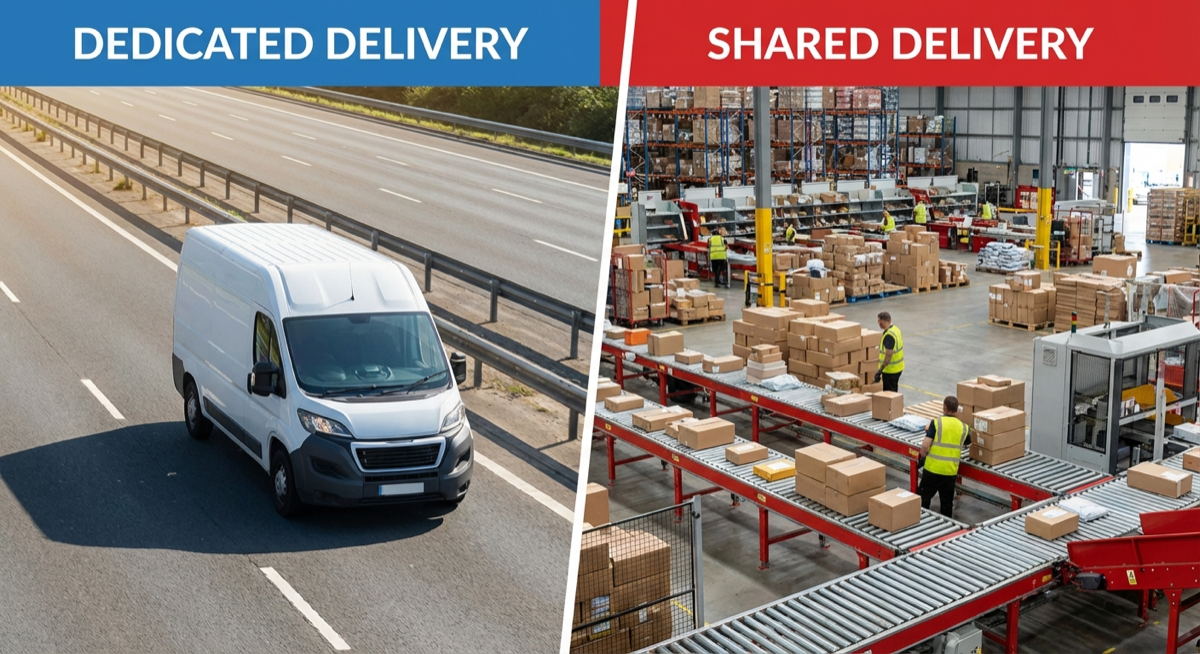
When healthcare providers need to send specimens, medications, or medical equipment, they typically have two choices: a shared courier network or a dedicated courier service.
Both will get your consignment from A to B — but the way they do it, and the level of care, accountability, and speed involved, is very different. For medical deliveries, that difference matters.
How Shared Courier Networks Work
Shared courier services — including national pallet networks and multi-drop delivery companies — operate on a hub-and-spoke model:
- Your consignment is collected alongside other items
- It travels to a local depot or sorting facility
- It's sorted, possibly transferred to another vehicle
- It's loaded onto a delivery route with dozens of other drops
- It eventually reaches the destination
This model is efficient for general parcels and non-urgent deliveries. It keeps costs low by consolidating multiple consignments into shared vehicles and routes.
But for medical deliveries, each of those steps introduces risk.
The Risks of Shared Networks for Medical Items
Delays at Every Stage
Each handover point — collection, depot, sorting, transfer, delivery — adds time. For specimens with tight viability windows, those extra hours can make the difference between a usable sample and a wasted one.
Multiple Handlers
Your consignment may pass through four or five pairs of hands before reaching its destination. Each handover is a point where items can be misplaced, damaged, or delayed.
No Direct Communication
In a shared network, you're dealing with a call centre or automated tracking system. You can't speak to the person actually carrying your goods, and real-time updates are limited.
Limited Proof of Delivery
A signature on a handheld device is often the only confirmation. There's no photographic evidence, no chain of custody documentation, and no record of how the item was handled.
No Special Handling
Drivers on shared routes handle hundreds of parcels daily. There's no capacity to follow site-specific procedures, wear particular PPE, or treat medical items differently from any other package.
How Dedicated Medical Couriers Work
A dedicated courier operates on a fundamentally different model:
- A single driver collects your consignment
- It travels directly to the destination in that same vehicle
- It's delivered with photo proof and direct confirmation
That's it. No depots, no sorting, no shared loads, no unnecessary handling.
The Benefits for Healthcare Providers
Speed
With no intermediate stops, dedicated deliveries are significantly faster. Same-day collections are often available within 60–90 minutes, and delivery follows immediately after.
Accountability
One driver, one vehicle, one route. You know exactly who's handling your consignment at all times, with photo proof of delivery and direct contact throughout.
Compliance
A dedicated courier can operate in line with your site procedures, SOPs, and handling requirements. They'll sign in at reception, follow handover protocols, and use appropriate PPE — because they're there specifically for your job.
Security
Unbranded vehicles, no shared loads, and a direct route from A to B. For confidential records, controlled medications, or high-value medical equipment, this level of security is essential.
Flexibility
Need a collection at short notice? A delivery outside normal hours? A regular scheduled service? A dedicated courier can adapt to your needs in a way that shared networks simply can't.
When Shared Networks Make Sense
To be fair, shared courier services have their place. For non-urgent, non-sensitive deliveries — office supplies, marketing materials, general stock replenishment — a shared service can be cost-effective and perfectly adequate.
But when the consignment is time-sensitive, fragile, confidential, or clinically important, the cost savings of a shared network are quickly outweighed by the risks.
Making the Right Choice
The question healthcare providers should ask isn't "which is cheapest?" but "which gives us the reliability, accountability, and care that our consignments require?"
For many providers across the East Midlands, the answer is increasingly clear: dedicated courier services deliver the certainty that medical deliveries demand.
About Roebuck Courier Service
We provide dedicated medical courier services across Derby, Nottingham, Leicester, and the wider East Midlands. Every delivery is a single dedicated run — fully insured, with photo proof of delivery and direct driver contact as standard.
Call us on 07412 554169 or visit our Medical Courier Services page to discuss your requirements.
Roebuck Courier Service
Family-run dedicated courier service based in Derby, serving the East Midlands and UK. Specialist medical courier services for healthcare providers.
Get in touch →