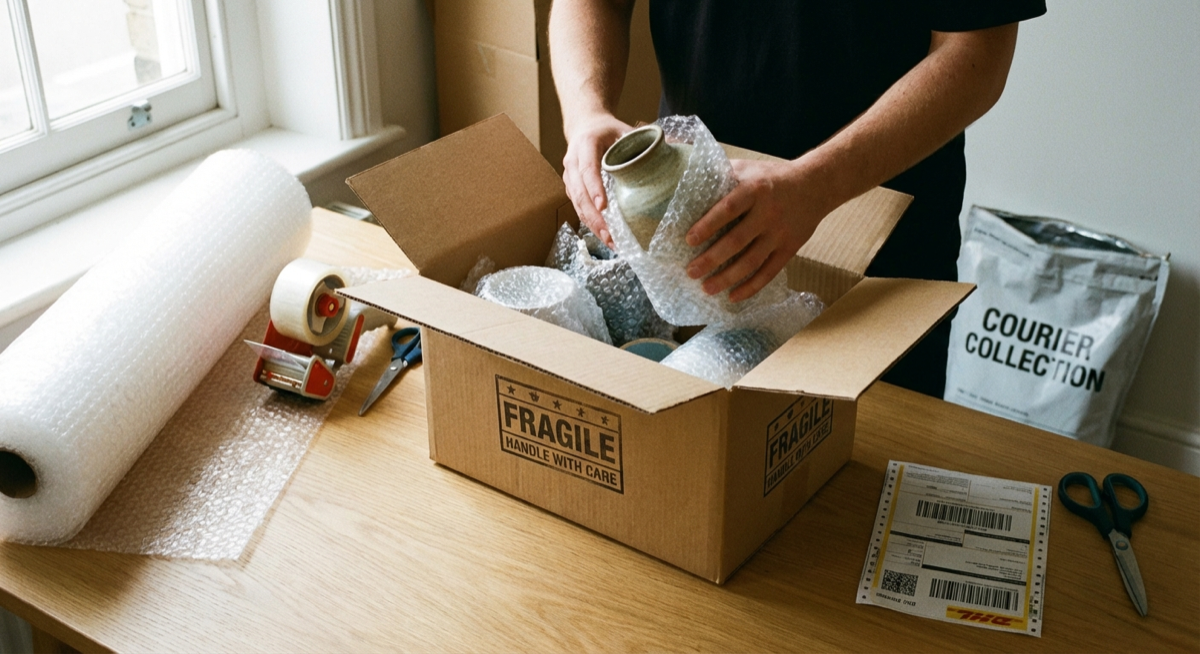
You've booked your courier, the driver is on the way, and you realise your consignment isn't quite ready. The box isn't sealed properly. There's no label. The delivery address is on a sticky note that's already fallen off twice.
It sounds trivial, but how you prepare items for courier collection directly affects the speed, safety, and success of your delivery. A few minutes of preparation can prevent delays, damage, and disputes — saving you time and money in the long run.
Why Does Preparation Matter?
Even with a dedicated courier service where your items travel alone in their own vehicle, proper preparation is important for several reasons:
- Protection. Adequate packaging protects your goods from vibration, movement, and the occasional bump that's inevitable in any road transport.
- Speed. If your items are ready when the driver arrives, the collection is fast and the delivery gets underway sooner.
- Accuracy. Clear labelling ensures the consignment goes to the right place, to the right person, with the right handling.
- Insurance. If goods are damaged in transit, inadequate packaging can complicate insurance claims. Proper packaging demonstrates due diligence.
How Should You Package Different Types of Items?
The right packaging depends on what you're sending:
Documents and paperwork. Use a sealed envelope or document wallet. For important originals — contracts, court filings, certificates — consider a rigid document mailer or cardboard-backed envelope to prevent bending.
Small packages and boxes. Use a sturdy box that's appropriately sized for the contents. Items should fit snugly — too much empty space allows movement, while cramming items into an undersized box risks crushing. Fill gaps with bubble wrap, packing paper, or air pillows.
Fragile items. Wrap each item individually in bubble wrap or foam. Use double-walled boxes where possible. The "drop test" rule applies: could this box survive being dropped from waist height? If not, add more protection.
Electronics and equipment. Anti-static packaging for sensitive electronic components. Original manufacturer's packaging is ideal if available. If not, ensure adequate cushioning on all sides.
Heavy items. Use reinforced boxes or crates. Distribute weight evenly. If an item is over 25kg, consider whether it can be split into smaller, more manageable units — or discuss handling arrangements with your courier in advance.
Liquids. Must be in sealed, leak-proof containers. Place in a secondary container (bag or tray) that can catch any leakage. Label as containing liquid. Note that some couriers have restrictions on certain types of liquids.
What Information Should Be on the Label?
Every consignment should be clearly labelled with:
- Recipient name — the specific person or department receiving the delivery
- Full delivery address — including postcode, building name, and floor/unit if applicable
- Contact phone number — in case the driver needs directions or access information
- Any special instructions — "Deliver to loading bay," "Call on arrival," "Fragile — handle with care"
- Sender's details — your name, address, and contact number for returns or queries
Labels should be securely attached and clearly legible. A label that peels off or smudges in the rain defeats the purpose.
What Should You Tell Your Courier Before Collection?
When booking, provide your courier with all the information they need to handle the collection smoothly:
- Number of items. How many boxes, packages, or items will the driver be collecting?
- Size and weight. Approximate dimensions and weight help the courier dispatch the right vehicle.
- Collection point. Where exactly should the driver come? Reception? Loading bay? Specific office?
- Access arrangements. Security gates, intercom codes, parking restrictions — anything the driver needs to know to reach your items.
- Ready time. When will the consignment actually be ready for collection? Don't book a collection for 10am if the items won't be packaged until 11am.
- Handling requirements. "Keep upright," "temperature-sensitive," "do not stack" — communicate these clearly.
Common Mistakes to Avoid
Based on years of experience, here are the most common preparation mistakes we see:
- Under-packaging. A single layer of bubble wrap isn't enough for fragile items. If in doubt, add more protection.
- Missing labels. Especially on multi-item consignments — every box should be labelled, not just the first one.
- Inaccurate weights. Significantly underestimating weight can result in the wrong vehicle being dispatched.
- Not being ready. A courier driver arriving to find the consignment isn't packed yet creates delays that affect the entire delivery schedule.
- Forgetting access details. Particularly for business premises with security, out-of-hours access codes, or restricted parking.
Get in Touch
At Roebuck Courier Service, we're always happy to advise on preparation and packaging for your specific consignment. We provide dedicated courier services across Derby, Nottingham, Leicester, and the wider East Midlands.
Call us on 07412 554169 or visit our Get a Quote page.
Roebuck Courier Service
Family-run dedicated courier service based in Derby, serving the East Midlands and UK. Specialist medical courier services for healthcare providers.
Get in touch →