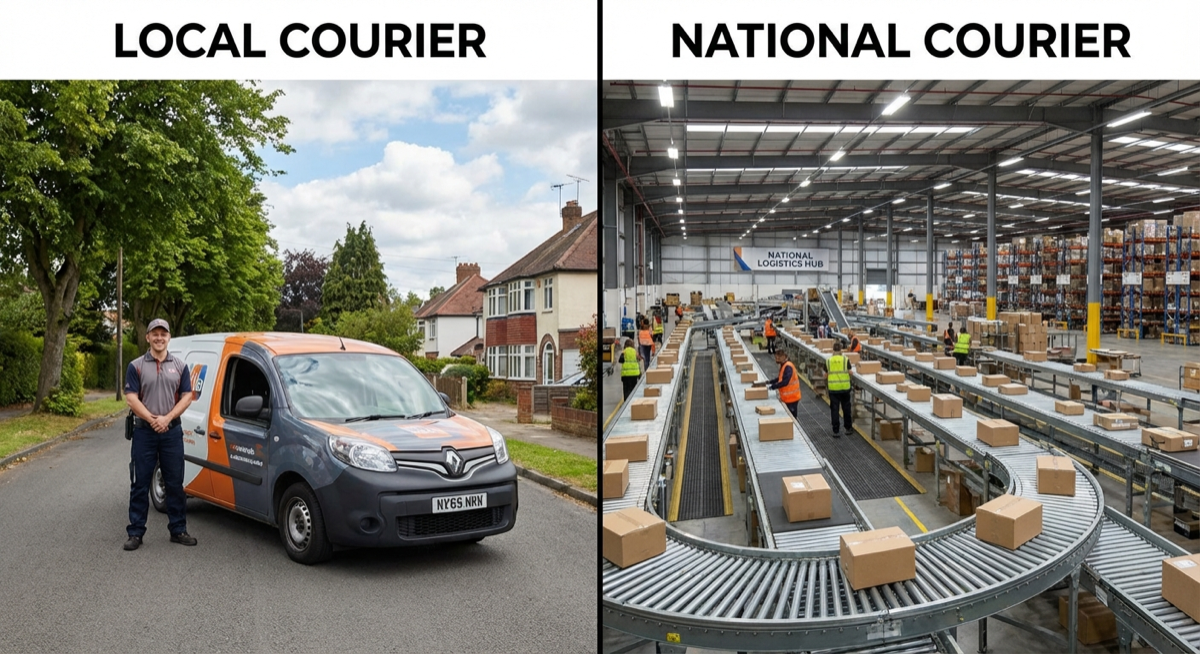
When it comes to choosing a courier service, businesses often face a fundamental decision: should they go with a local independent courier or a national delivery network? Both have their strengths, and the right choice depends on what you're sending, where it's going, and how important the delivery is to your business.
Let's break down the differences so you can make an informed decision.
What Is a Local Courier Service?
A local courier is typically an independent or small business operating within a specific region. They know the area, they handle deliveries personally, and they usually offer a more flexible, responsive service than larger operations.
At Roebuck, we're a family-run courier service based in Derby, covering the East Midlands and beyond. Our drivers know the local roads, industrial estates, and business parks — and our customers can speak directly to the people handling their deliveries.
What Is a National Courier Network?
National networks — companies like DPD, DHL, Hermes, and Royal Mail — operate at enormous scale, collecting and delivering millions of parcels daily across the UK. They use hub-and-spoke systems: parcels are collected, taken to a sorting depot, and then dispatched for delivery — often the following day.
These networks are highly efficient for standard parcel delivery and benefit from economies of scale that keep per-parcel costs low.
When Is a Local Courier the Better Choice?
Local couriers excel in situations where the national network model falls short:
Urgent, same-day delivery. National networks are built for next-day (or later) delivery. If you need something delivered today, a local same-day courier is almost always faster and more reliable.
Dedicated delivery. When your consignment needs to travel alone — without being sorted, stacked, or mixed with other parcels — a local dedicated courier is the only practical option.
Fragile or high-value items. Items that need careful handling are better served by a dedicated vehicle and a single driver than by a multi-stage network where they're loaded and unloaded multiple times.
Direct communication. With a local courier, you can call the driver directly. With a national network, you're speaking to a call centre — and the person on the phone typically has no direct contact with the person carrying your parcel.
Flexibility. Need a collection in 30 minutes? Want to change the delivery address mid-journey? Need a specific vehicle for an awkward load? Local couriers can accommodate requests that would be impossible within a national network's rigid systems.
Confidential deliveries. Unbranded vehicles and discreet handling are standard for many local couriers. National networks use branded vans and branded packaging — which may not be appropriate for sensitive consignments.
When Does a National Network Make More Sense?
National networks aren't without their advantages:
High-volume, non-urgent deliveries. If you're sending hundreds of standard parcels a week, a national network's per-parcel pricing and automated systems are hard to beat on cost.
Long-distance standard deliveries. For a next-day parcel from Derby to Edinburgh, a national network's infrastructure is well-suited. The parcel enters the system, travels through the network overnight, and arrives the following day.
Consumer deliveries. If you're an e-commerce business shipping to individual consumers across the UK, national networks offer the coverage and tracking systems that end consumers expect.
Standardised processes. Large networks have established processes for labelling, tracking, and returns that integrate with e-commerce platforms and warehouse management systems.
Can You Use Both?
Absolutely — and many businesses do. A smart logistics strategy uses each type of service for what it does best:
- National networks for high-volume, standard, next-day deliveries
- Local couriers for urgent, same-day, dedicated, or sensitive deliveries
This isn't an either/or decision. Think of a national network as your routine delivery solution and a local courier as your specialist partner for everything else.
What About Cost?
On a per-parcel basis, national networks are typically cheaper — they benefit from enormous scale and highly optimised routing. But cost per parcel doesn't tell the whole story.
A national network delivery that arrives late, arrives damaged, or doesn't arrive at all has hidden costs: lost customers, replacement goods, wasted production time, and damage to your reputation.
A local dedicated courier might cost more per delivery, but the reliability, speed, and accountability often make it better value — particularly for important consignments where failure isn't an option.
The Local Advantage in the East Midlands
The East Midlands is a region with a dense concentration of manufacturing, engineering, healthcare, and professional services businesses. Many of these businesses need deliveries within the region — between Derby, Nottingham, Leicester, and the surrounding towns.
For these intra-regional deliveries, a local courier offers unbeatable speed and value. There's no need to send your consignment through a national hub in Birmingham when it's going from one Derby postcode to another.
Get in Touch
At Roebuck Courier Service, we provide dedicated local courier services across Derby, Nottingham, Leicester, and the wider East Midlands — with UK-wide delivery available when you need it.
Call us on 07412 554169 or visit our Get a Quote page.
Roebuck Courier Service
Family-run dedicated courier service based in Derby, serving the East Midlands and UK. Specialist medical courier services for healthcare providers.
Get in touch →