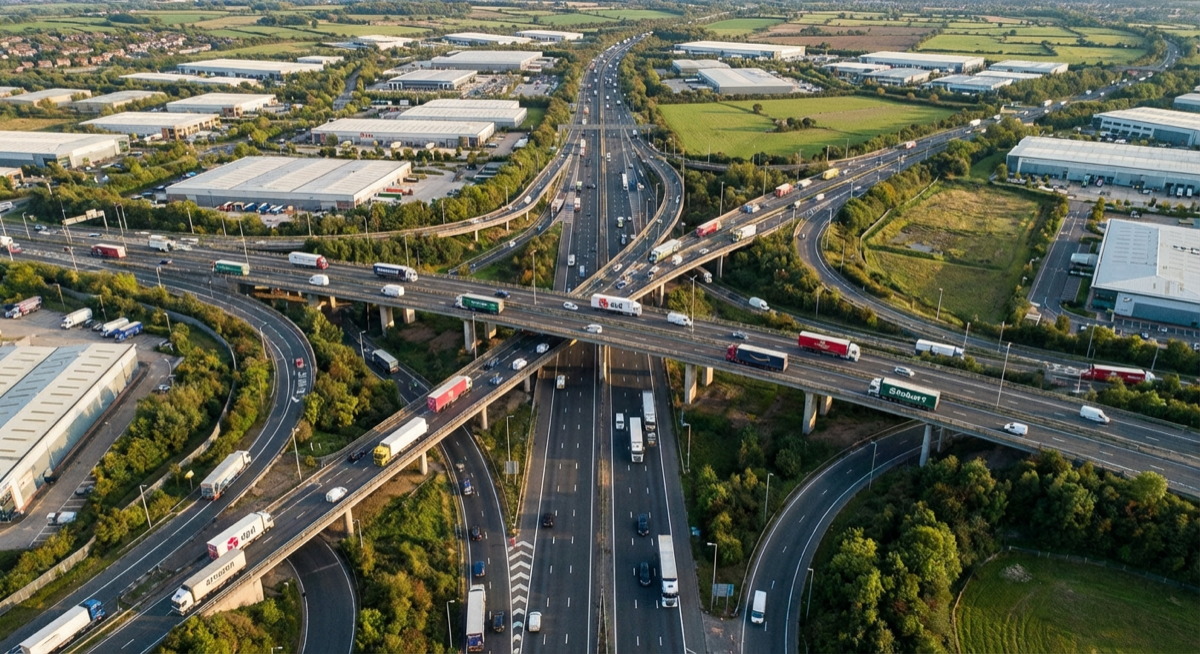
When people think of supply chains, they tend to picture container ships, warehouses, and articulated lorries. The big, visible infrastructure of global logistics. But there's a less visible — yet equally critical — layer that keeps UK businesses running day to day: couriers.
Couriers operate in the gaps, handling the urgent, the unexpected, and the time-critical. They're the connective tissue between the major logistics arteries, and for many businesses, they're the difference between a supply chain that works and one that breaks down.
Where Do Couriers Fit in the Supply Chain?
UK supply chains operate on multiple levels, from international freight down to last-mile delivery. Couriers primarily operate in the middle and lower tiers — but their impact reaches across the entire chain:
First-mile collection. Collecting goods from manufacturers, suppliers, and distributors and moving them into the logistics pipeline. For small-batch or time-sensitive consignments, a courier collection is often faster and more practical than waiting for a scheduled haulage pickup.
Inter-site transfers. Moving materials, components, and documents between a company's different locations — factories, offices, warehouses, and retail sites.
Supplier-to-production delivery. Getting parts and materials from suppliers directly to production lines. This is particularly critical in just-in-time manufacturing, where even minor supply disruptions can halt production.
Emergency and exception handling. When the planned supply chain breaks down — a delivery is delayed, a component is defective, a supplier runs short — couriers provide the rapid-response capability to fix the problem before it cascades.
Last-mile delivery. Getting finished products, documents, and consignments to their final destination — whether that's a customer, a client, a court, or a hospital.
Why Are Couriers Increasingly Important?
Several trends are driving increased reliance on courier services within UK supply chains:
Just-in-time manufacturing. The move away from large inventory holdings means businesses need reliable, responsive delivery to maintain production schedules. When stock is minimal, any supply disruption requires an immediate courier response.
E-commerce growth. The explosion of online retail has created enormous demand for fast, flexible delivery — including same-day options that traditional logistics networks can't provide.
Customer expectations. Both B2B and B2C customers expect faster delivery than ever before. Next-day is the new standard; same-day is increasingly expected for urgent and premium orders.
Supply chain disruption. Recent years have demonstrated the fragility of global supply chains. When planned logistics fail — due to weather, strikes, border issues, or global events — couriers provide the agility to work around disruption.
Specialisation. Many consignments require specialist handling — medical specimens, legal documents, fragile equipment, temperature-sensitive materials. Dedicated courier services provide the careful, specialised handling these items need.
How Do Couriers Support Supply Chain Resilience?
Supply chain resilience — the ability to absorb and recover from disruption — is a top priority for UK businesses. Couriers contribute to resilience in several ways:
- Rapid response. When something goes wrong, a courier can be dispatched within minutes. This speed of response limits the impact of supply chain disruptions.
- Flexibility. Couriers aren't tied to fixed routes, schedules, or networks. They go where needed, when needed — adapting to the situation in real time.
- Redundancy. Having a reliable courier partner provides a backup option when primary logistics fail. It's insurance against supply chain disruption.
- Scalability. Courier capacity can be scaled up or down quickly, without the capital investment required for in-house logistics.
The East Midlands Supply Chain Network
The East Midlands is one of the UK's key logistics regions. Its central location makes it a natural hub for distribution, with major transport links including the M1, A50, and East Midlands Airport.
The region's manufacturing base — spanning aerospace in Derby, engineering in Nottingham, and textiles and food production in Leicester — creates a dense network of supply chain relationships where reliable courier services are essential.
As a courier based in this region, Roebuck understands the local supply chain landscape. We know the manufacturers, the suppliers, the industrial estates, and the logistics hubs — and we know how to move goods between them quickly and reliably.
Building Courier Services into Your Supply Chain Strategy
Rather than treating courier services as an emergency measure, forward-thinking businesses build them into their supply chain planning:
- Identify your critical paths. Where in your supply chain would a disruption have the biggest impact? These are the points where having a courier on standby is most valuable.
- Establish a relationship. Don't wait for an emergency to find a courier. Build a relationship now so that when you need urgent delivery, your courier knows your business and can respond immediately.
- Agree on terms. Set up an account with agreed pricing, service levels, and escalation procedures. This saves valuable time when urgency strikes.
- Test the system. Use your courier for routine deliveries so you're confident in their service before you need them for an emergency.
Get in Touch
At Roebuck Courier Service, we provide reliable, dedicated courier services that keep supply chains moving across Derby, Nottingham, Leicester, and the wider East Midlands.
Call us on 07412 554169 or visit our Get a Quote page.
Roebuck Courier Service
Family-run dedicated courier service based in Derby, serving the East Midlands and UK. Specialist medical courier services for healthcare providers.
Get in touch →